
The Children of John McGowan and Elizabeth Chrystal Neil – Some Analysis
Elizabeth Chrystal Neil was my great-aunt. I wanted to analyse Elizabeth’s and her husband, John’s, family because of the number of children they had – fourteen that I found. I wondered what that felt like; how long was it between births; how many children were alive at any one time, what was the infant mortality like? How many children were under sixteen at any one time, When did they marry?; How long did they live? etc.
I built a spreadsheet that showed the lifespan of mother, father and all the children and I calculated the time between births. Some of this can be seen in the following table:
| No | Child | DOB | Time Between | Span | Age at Death |
|---|---|---|---|---|---|
| 1 | Mary Ann McGowan | 16-Jun-1914 | First Child | (1914-1988) | 83 |
| 2 | Dorothea McGowan | 27-Jul-1915 | 1y 1m 11d | (1915-1994) | 78 |
| 3 | John Neil McGowan | 18-May-1917 | 1y 9m 21d | (1917-1972) | 55 |
| 4 | Charles Neil McGowan [1] | 15-Apr-1920 | 2y 10m 28d | (1920-1922) | 1y 9m |
| 5 | Elizabeth Neil McGowan | 26-Mar-1922 | 1y 11m 11d | (1922-) | |
| 6 | William Baird McGowan | 03-Jun-1923 | 1y 2m 8d | (1923-1923) | 6m |
| 7 | George Baird McGowan | 04-Aug-1924 | 1y 2m 1d | (1924-1998) | 73 |
| 8 | Grace Baird McGowan [1] | 11-Sep-1925 | 1y 1m 7d | (1925-1929) | 3 |
| 9 | Timothy Neil McGowan | 07-Nov-1926 | 1y 1m 27d | (1926-1971) | 44 |
| 10 | Charlotte Baird McGowan | 15-Aug-1928 | 1y 9m 8d | (1928-1929) | 4m |
| 11 | Grace McGowan [2] | 11-Sep-1930 | 2y 0m 27d | (1930-2014) | 84 |
| 12 | Susan Neil McGowan | 05-Jun-1931 | 0y 8m 25d | (1931-1934) | 2 |
| 13 | James McGowan | 25-Jan-1935 | 3y 7m 20d | (1935-1981) | 46 |
| 14 | Charles McGowan [2] | 30-Nov-1936 | 1y 10m 5d | (1936-1991) | 54 |
A Note on the Historical Background
Elizabeth Chrystal Neil married John McGowan at the Roman Catholic Church of St John the Evangelist, in Portugal Street, Glasgow as many of the wider family did. They married on 24 Apr 1914. The great War (World War I) began with Austria-Hungary’s declaration of war against Serbia on July 28, 1914. On 4 August 1914, King George V declared war on the advice of his prime minister, H. H. Asquith, leader of the Liberal Party. The first three of their children, Mary Ann (1914), Dorothea (1915) and John Neil (1917) were born during this conflict.
With a population of 4.8 million in 1911, Scotland sent 690,000 men to the war, of whom 74,000 died in combat or from disease, and 150,000 were seriously wounded. World War I officially ended for the United Kingdom (and other Allied powers) on November 11, 1918, with the signing of the Armistice agreement with Germany. By the end of the war, Elizabeth ran a household of just the above three children now aged 4y, 3 and 1½.
The post-war period was another great challenge to the country as an economic slump, coupled with new technologies and reduced international trade, impacted key industries like shipbuilding and coal, leading to widespread unemployment and economic hardship. Scotland experienced a significant population decline, with the highest emigration rate in Europe during the interwar period. Many Scots sought opportunities in the British Empire, particularly in Canada.
It is quite hard to imagine the household at various points in the development of the family; the only census return we have for them is the 1921 Census.
John McGowan and Elizabeth Chrystal Neil at the 1921 Census 10½ Eglinton Lane, Glasgow
![1921-06-19 CEN John McGowan + Elizabeth Chrystal Neil - 10 1/2 Eglinton Lane [[N273-clip]]](https://familycopy2025-12-04.billneil.org/wp-content/uploads/2025/07/N273-clip.jpg)
| Name | Rel | Age | Sex | Mar/Orph | Birthplace | Occupation | Status | Employment |
|---|---|---|---|---|---|---|---|---|
| John McGowan | Head | 25y 1m | M | M | Glasgow, Lanarkshire | Labourer | W | Smith & McLean Galvanisers |
| Elizabeth McGowan | Wife | 26y 11m | F | M | Glasgow, Lanarkshire | Home Duties | ||
| Mary Ann McGowan | Dau | 7y 0m | F | S | Glasgow, Lanarkshire | Scholar | ||
| Dorothea McGowan | Dau | 5y 11m | F | S | Glasgow, Lanarkshire | Scholar | ||
| John McGowan | Son | 4y 1m | M | S | Glasgow, Lanarkshire | |||
| Charles McGowan | Son | 1y 2m | M | S | Glasgow, Lanarkshire |
1921 Census Return for 10½ Eglinton Lane, Gorbals, Glasgow Scotland’s People (1921 Scotland Census, 1921 MCGOWAN, ELIZABETH (Census 644/17 22/ 5) Page 5 of 34
Seven years after their marriage finds John, aged 25y 1m and a labourer at Smith & McLean Galvanisers (merchants, manufacturers, galvanizers, steel and iron plate and sheet rollers). Elizabeth is now 26y 11m old and they have four children; Mary Ann (7y) and Dorothea (5y 11m) are both scholars but John (4y 1m) and Charles (1y 2m) are too young to be at school. As we have seen, Charles was to die less than a year later leaving the household with just three children.
Family Size
John and Elizabeth had no more children in 1918 or 1919 but then came a succession of nine children, every other one of which died in infancy; they had Charles (1920-1922), Elizabeth (1922), William (1923-1923), George (1924), Grace (1925-1929), Timothy (1926), Charlotte (1928-1929), Grace (1930), and Susan (1931-1934). So out of nine children born between 1920 and 1931, four lived beyond infancy and five did not. (The causes of their deaths are described below) This sad run of alternating deaths was broken by the birth of James (1935) and Charles (1936). In all then five of the 14 children died and nine lived.
The family, living at 10½ Eglinton Lane in 1921, did start to grow from 1924 onwards – Elizabeth was aged 29 then. Usually there was just one under 3 year-old at a time in the family. In 1928-1929 there were 2 briefly but they both died in 1929; Charlotte on 2 January, aged 4 months, and Grace a week later on 9 January, aged 3 years. This left the family with six children but Mary Ann was now aged 15 and Dorothea aged 14 and one can assume at that age that they at least contributed a considerable amount to the housework – perhaps they also worked in some capacity as well.
Four other children were to be born; Grace [2] (1930), Susan (1931-1934), James (1935) and Charles [2] (1936). By the time of Charles’s birth the other, surviving, children were 22, 21, 19, 14, 12, 10, 6 and 1. So if you take out the babies who did not survive infancy and the working age adults, the number of dependent children in the family was abut 7 at a maximum and, after 1934, decreasing with each year so that in 1942 only four of them were under 18 years of age. I do not know how the family dispersed over the years as there are no Census returns to tell us but in 1939 the first of their children married and then others in 1945, 1948, 1952, 1955 and Charles, the last born, marrying in 1957. Their father, John McGowan died in 1948 so did not live to see all of these marriages but their mother, Elizabeth Chrystal McGowan or Neil did, living another eight years after Charles’s marriage, dying in 1965 aged 70. She had borne fourteen children in a 22 year period; she had to bury five of them and then her husband of 34 years who she married when he was 17 years old. She outlived him by another 17 years.
Before moving on to what happened to other aspects of their life as a family, I turn briefly to causes of death of the infants.
The Causes of Death of the Children Who Died in Infancy
Of the 14 children, only nine lived beyond three years of age. Charles died, aged 1 ¾ years from “pneumonia”; William died, aged 6 months from “infantile paralysis, convulsions”; Grace died, aged 3 from “broncho pneumonia, enteritis”; and Charlotte died aged 4 moths from “acute broncho pneumonia, enteritis”. The recurrence of pneumonia as a cause of death is striking.
Did the Surviving Children Marry and, if so, at what age?
The children that survived childhood lived long enough that, for most of them, their marriage registrations are not available online. To purchase them all would be a needless expense. I have had to settle for index entries.
| Name | Date of Marriage | Age at Marriage |
|---|---|---|
| Mary Ann McGowan | 18-Jun-45 | 31 |
| Dorothea McGowan | 30-Nov-39 | 24 |
| John Neil McGowan | 1953 | 35 |
| Charles Neil McGowan [1] | died as child | |
| Elizabeth Neil McGowan | 25-Feb-49 | 26 |
| William Baird McGowan | died as child | |
| George Baird McGowan | could not find a marriage | |
| Grace Baird McGowan [1] | died as child | |
| Timothy Neil McGowan | 1955 | 29 |
| Charlotte Baird McGowan | died as child | |
| Grace McGowan [2] | could not find a marriage | |
| Susan Neil McGowan | died as child | |
| James McGowan | could not find a marriage | |
| Charles McGowan [2] | 1957 | 21 |
The following table shows just the marriages we know of:
| Name | Date of Birth | Married | To | Age |
|---|---|---|---|---|
| Mary Ann McGowan | 16-Jun-14 | 18-Jun-45 | John Patrick Brady | 31 |
| Dorothea McGowan | 27-Jul-15 | 30-Nov-39 | Herny Bradford | 24 |
| John Neil McGowan | 18-May-17 | 1953 | Rachel Finlay Paton | 35 |
| Elizabeth Neil McGowan | 26-Mar-22 | 25-Feb-49 | John Fulton Doran Grant Russell | 26 |
| Timothy Neil McGowan | 07-Nov-26 | 1955 | Doreen Catherine Barr | 29 |
| Charles McGowan [2] | 30-Nov-36 | 1957 | Catherine Brodie | 21 |
So, despite their parents marrying at 18 and 17 years old, for their children, the youngest age at marriage is 21 (Charles McGowan – the last born child) and the oldest, 35 (John Neil McGowan).
The Causes of Death of those who lived to Maturity
The children that survived childhood lived long enough that, for most of them, their death registrations are not available online. To purchase them all would be a needless expense. I have had to settle for index entries.
Mary Ann McGowan married John Patrick Brady in 1945 when she was aged 31. I believe she died, aged, 83, in 1998 and her death was registered at RD Glasgow, Martha Street.
Dorothea McGowan married Henry Bradford in 1939; they were both said to have usual residence of 360 Cumberland St. As far as I know she died, aged 78, in 1994 and her death was registered at RD Glasgow, Martha Street.
John Neil McGowan died in 1972, aged 55 from(1a) Pulmonary Oedema, (1b) Pulmonary Embolism [2] Cerebral Haemorrhage. His widow, Rachel Finlay Paton of 50 Kennishead Avenue, Glasgow was the informant. He died in Southern General Hospital.
Elizabeth Neil McGowan is a bit of a mystery; I have not found her again after her marriage in 1949 to John Fulton Doran Grant Russell. I have not found a death for him but I believe he died in RD East Kilbride in1983 when he would have been aged 68.
George Baird McGowan is also a bit of a mystery; I have not found her again after her marriage in 1949 to John Fulton Doran Grant Russell. I have not found a death for him but I believe he died in RD East Kilbride in1983 when he would have been aged 68. He was the informant at the death registration of his mother Elizabet Chrystal Neil or McGowan. Her usual residence was 73 Brockburn Road, Glasgow but I do not know if he lived there. I have not found a marriage for him but I believe he died in RD Glasgow, Martha Street in 1998 when he was aged about 73
Timothy Neil McGowan I believe he married Doreen Catherine Barr in 1955. There are a couple of possible children for him but he died, aged 44, at 44 Linnhead Drive. He was buried at St Peter’s Dalbeth Cemetery, Glasgow
Grace McGowan I do not think she married. She was a witness at the marriage of her sister, Elizabeth to John Fulton Doran Grant Russell in 1949. She signed as Grace McGowan of 166 Leithland Road; she would have been aged about 19. I believe she died, aged 84, as Grace McGowan, suggesting she was a spinster) and her death was registered in RD Martha Street in 2014
James McGowan I know nothing of him, except I think he died in 1981, aged about 46. His death is registered at RD Gorbals. Oddly his mother’s ms is given as O’Neil
Charles McGowan I believe he married Catherine Brodie in 1957 when he was aged about 21. The marriage is registered at RD Gorbals. I believe he died in 1991, aged 54, and the heath is registered at RD Eastwood and Mearns. Like James, above, his mother’s ms is given as O’Neil.
Where They Lived
The Streets
Elizabeth Chrystal Neil was born in 1895 at 122 Naburn Street, which ran at right angles both sides of what was then Caledonia Road with Hutcheson Square at one end. By the time of the 1901 Census the family lives at 21 Salisbury Street to the west of Naburn Street; it ran between Cavendish and the junction of Cumberland Street and Pollockshaws Road. By 1914 the family lived at 10 Eglinton Lane, a small lane running off Eglinton Street (which became the main tramway). This is where she lived at the time of her marriage to John McGowan but it seems they soon moved out of her parent’s home and set up in 50 Cavendish Street, where their first child, Mary Ann, was born later in 1914. Cavendish Street was at a right angle to the end of Salisbury Street and ran between Eglinton Street and Pollockshaws Road. Their next child, Dorothea was said to have been living at 8 Eglinton Lane but I do not have any other record of the family at that address. By the next child, John Neil McGowan, the family were at 21 Surrey Street, which could have been the household of Elizabeth’s parents, John Neil and Mary Anne Chrystal. In fact various branches of the family seem to move around between Surrey Street and Eglinton Lane. From the birth of Charles in 1920 we see the family living at 10½ Eglinton Lane. The family were at this address at the 1921 Census. I do not know where the following children were born but it was likely still 10½ Eglinton Lane as this is where Susan Neil McGowan died in 1931, aged 2.
A Map of the Streets they were born in.
These streets are highlighted below on a section of a hand-drawn map of Gorbals circa 1910 in Eric Eunson’s valuable book, “The Gorbals: An Illustrated History” I have also highlighted Portugal Street where many Neils married in St John the Evangelist RC Church which is noted at the north end of the street.
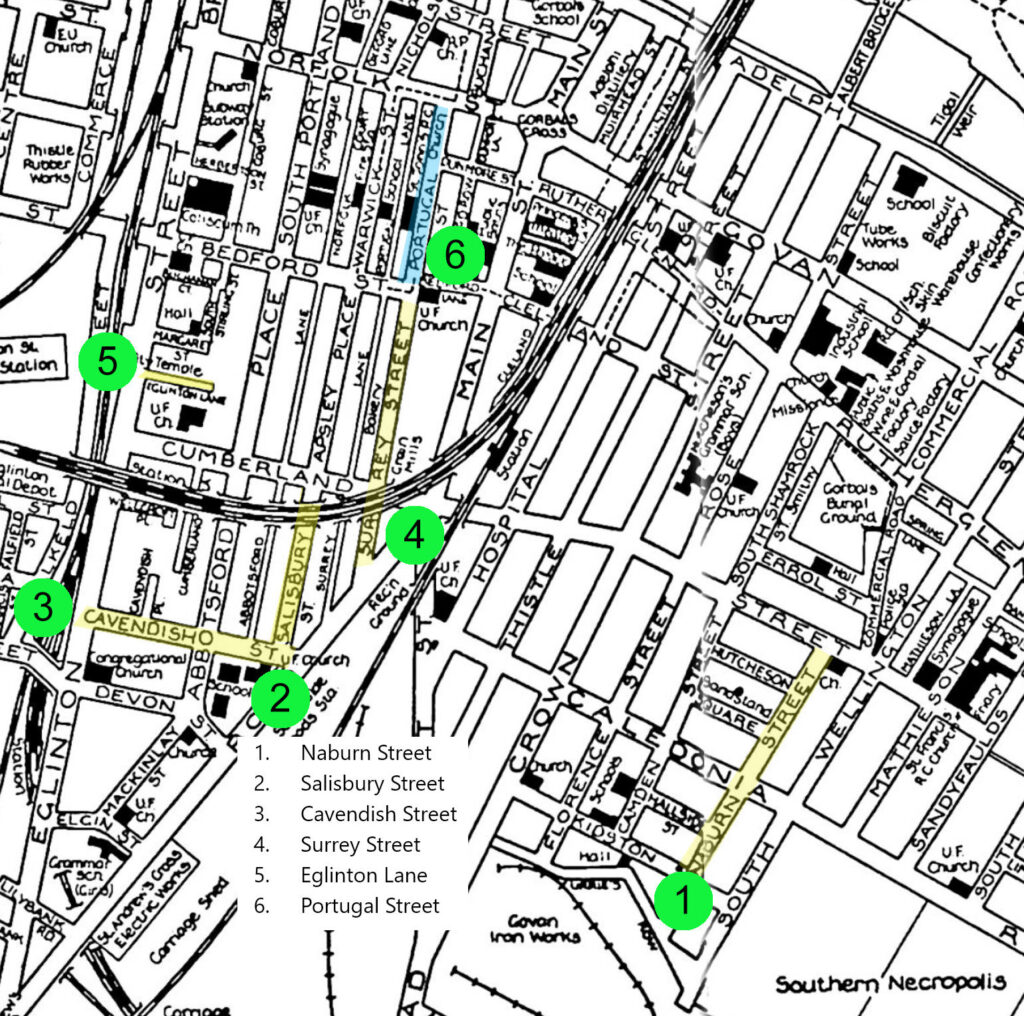
All these streets are recorded in the 1911 Glasgow Post Office DIrectory:
- Gi Naburn St., between Cumberland st. and Caledonia rd. 15. (Page 44)
- Fi Salisbury Street, from Cumberland street to Pollokshaws road. 17. (p48)
- Fi Cavendish St., from Pollokshaws rd. to Eglinton street. 17. (p28)
- Fi Surrey St., f. Portugal st. to. Pollokshaws rd. 17. (p50)
- Fi Eglinton Lane, off Eglinton Street. 17 (Page 32)
- Fi Portugal Street, f. Norfolk st. to Surrey st. 17. (page 46)
When John McGowan died in 1948 he is said to be living at 166 Leithland Road and when Elizabeth died herself, she was recorded as residing at 73 Brockburn Road; both these streets appear to be in the Crookston area of Glasgow, a residential suburb on the southwestern edge of the city. They do not appear in the 1911 Glasgow Post Office DIrectory
1911 Glasgow Post Office Directory: Municipal Wards of Gorbals and Hutchesontown Outlined.
The same 1911 Post Office Directory lists the Municipal Wards and describes the Municipal Ward of Gorbals as:
Municipal Ward of Gorbals
XIX. Ward, Gorbals.—That portion of the City comprehended within a line drawn from a point in the middle line of Glasgow Bridge where the same intersects the middle line of the River Clyde, southwards along the middle of said bridge. Bridge Street, Eglinton Street, and Victoria Road to a point where the said road is intersected by the Parliamentary boundary north of Allison Street ; thence following the Parliamentary boundary eastwards, northwards, northeastwards, eastwards, and northwards to the middle of Butterbiggins Road ; thence eastwards along the middle of Butterbiggins Road to the middle of Cathcart Road; thence northwards along the middle of Cathcart Road and Crown Street to the middle of Caledonia Road ; thence westwards along the middle of Caledonia Road to the middle of Thistle Street thence northwards along the middle of Thistle Street to the middle of the River Clyde ; thence westwards down the middle of the River Clyde to the middle of Glasgow Bridge, at the point first before described.
Municipal Ward of Hutchesontown
It describes the Municipal Ward of Hutchesontown:
XVIII. Ward, Hutchesontown.—That portion of the City within a line drawn from a point in the middle of the River Clyde opposite the middle of Rose Street, southwards along the middle of Rose Street and Florence Street to the middle of Caledonia Road; thence eastwards along the middle of Caledonia Road
to the middle of South Wellington Street; thence southwards along the middle of South Wellington Street to the middle of a proposed new street which
is distant thirty-four yards or thereby measured in a southerly direction from the south-west corner of the boundary wall of the Southern Necropolis; thence
south-eastwards along the middle of said proposed new street until it is intersected by the Parliamentary boundary of the City ; thence eastwards, northwards, north-westwards, and northwards along the said Parliamentary boundary to the middle of the River Clyde ; thence down the middle of the River Clyde to the point opposite the middle of Rose Street first before described.